

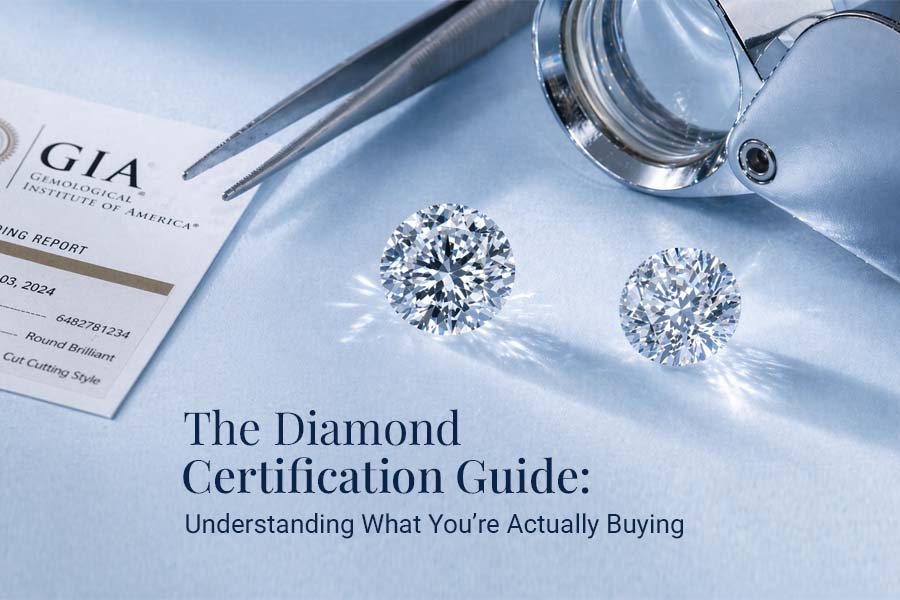
Introduction: Why Jewelry Certification Is Your Best Protection
As you begin your quest for a diamond, you may find that the world of carats, cuts, and clarity can feel like a foreign language to you. You need to have a sense of certainty about what you are paying for, whether you are selecting a meaningful present or an engagement ring to commemorate a moment that will only happen once in a lifetime.
If you’ve been hunting for a jewelry shop in Indianapolis that skips the industry jargon and actually prioritizes transparency, you’re in the right place. To be honest, a certification report isn’t just a piece of paper—it’s your best defense against confusion. Think of it as a neutral, third-party "passport" for your stone. It is important to understand why this is significant and how it may assist you in navigating the market with complete and utter tranquility before you go out and look for diamond engagement rings online.
What Exactly is a Diamond Grading Report?
At its heart, a diamond certification is simply an objective analysis from a professional gemological lab. These labs don't sell jewelry, so they have no skin in the game—their only job is to grade the stone exactly as it is.
When you look at a certificate (or a "grading report," as the pros call it), you’re getting an unbiased snapshot of your diamond’s DNA. Reputable organizations like the GIA (Gemological Institute of America) set the bar globally for these assessments. Without this kind of verification, buying a diamond feels like a guessing game. How can you compare two stones if you don't know the facts? A certificate removes that uncertainty, giving you a clear baseline to compare value fairly.
The 4Cs: Breaking Down the Basics
You’ve probably heard of the "4Cs," but let’s look at what they actually mean in the real world:
- Cut: This is arguably the most important one. It isn't just the shape (like round or pear); it’s how the diamond is fashioned to play with light. A great cut is what makes a diamond dance and sparkle when it catches the light. Without a precise cut, even the most expensive diamond can look dull.
- Color: Diamonds are graded on a scale from D (which is ice-cold, colorless) all the way to Z. While it’s hard for the naked eye to tell the difference between a few grades, that subtle shift is a massive factor in the price tag. We generally recommend staying in the D-G range for maximum brilliance.
- Clarity: This measures if there are any tiny internal "birthmarks" called inclusions. Most diamonds have them, but the fewer there are, the more light can travel through, and the rarer the stone becomes.
- Carat: People often mistake this for size, but it’s actually just the weight of the stone. A diamond's cut can have a greater impact on how big it seems than carat weight alone.
Why the 4Cs Matter To You
Think of the 4Cs as a balancing act. You don't always need a "perfect" rating in every category to have a beautiful diamond. Our objective is to assist you prioritize the Cs that are most important to your vision and budget. Understanding these pillars gives you the confidence to recognize actual value rather than simply hunting for the biggest price tag.
When you walk into the best jewelry store around, don’t feel pressured to know it all right away. A good jeweler will be happy to pull out the report and walk you through these specs. The fact that they are hesitant or appear to be upset by your questions is typically an indication that you should go elsewhere.
Why We Push for Rigorous Certification
Let’s be real: the jewelry industry has a reputation for high-pressure sales and confusing tactics. It’s easy to feel overwhelmed, but that’s exactly why certification is your best friend. It takes the emotion and the "sales pitch" out of the equation so you can focus on the hard facts.
Trust Starts Here in Indianapolis
Whether you’re stopping by from Castleton Square Mall or driving in from across the city, choosing a jeweler who insists on top-tier lab certification is the smartest way to de-risk your purchase. When a diamond is backed by a major lab, you don’t have to wonder if the color or clarity is inflated. It’s written in black and white. That kind of transparency is the foundation of our relationship with our customers.
Pricing: Why Some Diamonds Cost More
We understand that you are looking at two diamonds that appear to be the same to the human eye, yet the prices between them are radically different. It’s frustrating. But this is where the certificate earns its keep. A diamond with an "Excellent" cut grade will always cost more than a "Fair" one, even if they weigh the same. That price difference isn't arbitrary; it’s based on performance and quality.
When you know how to read the data, the pricing starts to make sense. If you’re ready to start looking, feel free to shop for diamonds in Indianapolis with us. We love showing our clients exactly what they’re looking at so they can feel confident in their choice.
How to Double-Check Your Stone
The coolest part about a certified diamond? You can verify it yourself. Most high-end labs laser-inscribe a tiny ID number on the edge (the girdle) of the stone.
- Examine the report and locate the serial number that corresponds to it.
- Enter that number on the laboratory's official website to verify the information. You can do this online.
- Verify the match by making sure the weight, dimensions, and form of the stone you are holding match the certified report from the lab.
It's a quick and easy way to confirm that the diamond you're purchasing is the one that the lab actually graded.
Frequently Asked Questions About Diamond Quality and Certification
An appraisal is a way to figure out how much money a diamond is worth, mainly for insurance purposes. A certificate (or grading report), on the other hand, is a purely scientific, physical analysis of the diamond's quality, size, and other features. You need the certificate to show what the diamond is and the evaluation to make sure you know how much it is worth.
Shopping for a large item, such as a diamond engagement ring, should raise a red flag if diamonds are not certified a reputable lab like the GIA or AGS. Therefore, it is best to verify that a reputable jeweler has provided a certificate prior to purchasing a diamond. Always verify this information with the jeweler before making any purchases.
Although certification requires a fee for the lab's expert time and official equipment, it is a security investment. It furnishes you with a permanent, impartial record of your diamond, guaranteeing that you will never be required to make guesses about its authenticity or quality.
The price of a diamond is driven by the 4Cs (Cut, Color, Clarity, Carat). Two stones can weigh the same (carat), but if one has a better "Cut" (meaning it sparkles more) or a higher "Clarity" (fewer internal flaws), it will be more valuable. The grading report clearly explains these differences.
This is where the laser inscription comes in. A trustworthy jeweler will show you the diamond under a microscope or loupe, allowing you to match the laser-inscribed serial number on the diamond's edge to the number printed on your grading report.
There are a lot of credible labs that also contribute to "Origin" reports, even though certification is mostly focused on quality grades (the 4Cs). We continually encourage our customers to inquire about the journey that the diamond took from the mine to the market in order to guarantee that it complies with ethical standards.
It depends on your personal vision. Most experts suggest prioritizing Cut first, as it dictates how much the diamond sparkles. After that, it comes down to personal preference. We love helping our clients balance these factors to get the most "bang for their buck."
If you choose a respected, local jewelry store in Indianapolis, like Sam's Jewelers, you may see the diamond in person, check the certification with your own eyes, and get to know a staff that will take care of you for a long time. Online-only stores don't always offer the same level of personalized attention and security as a local store you may visit.
Let’s Work Together
The process of selecting jewelry ought to be a thrilling achievement rather than a stressful endeavor. At the end of the day, knowledge is your best tool.
If you’re local to the Indianapolis area and want to talk to a team that values your questions, we’re here to help. We’d much rather spend time educating you than pushing you into a sale. Whether you’re ready to order a custom diamond piece online or you want to sit down in person and compare stones side-by-side, we’re committed to making sure you leave happy.


